
Disability
Overview
Although the word "disability" can be complex in its definition and application, the ACS uses six questions to determine if a person has a disability. Each question asks if a person has difficulty with a specific action or function. For each of these six questions, there's a table which provides responses broken down by sex and age group.
Hearing difficulty (B18102): deaf or has serious difficulty hearing
Vision difficulty (B18103): blind or has serious difficulty seeing even with glasses
Cognitive difficulty (B18104): has serious difficulty concentrating, remembering, or making decisions
Ambulatory difficulty (B18105): has serious difficulty walking or climbing stairs
Self-care difficulty (B18106): has difficulty dressing or bathing
Independent Living difficulty (B18107): has difficulty doing errands alone such as visiting a doctor’s office or shopping
Disability Status
Disability status is simply defined as having one or more of the difficulties listed above. However, for children under five, only hearing and vision difficulties are considered. Independent living difficulty is also only applied to adults.
All data sources are from the American Community Survey unless otherwise noted.
Indicators on the Profile Page |
Why It's Important |
|---|---|
Time and Means of Transportation |
|
|
|
Methodology
American Community Survey Data
From the Census: Why We Ask: Disability
From the Census: Guidance for Data Users: How Disability Datea are Collected from The American Community Survey
Sample Survey Questions on this Topic
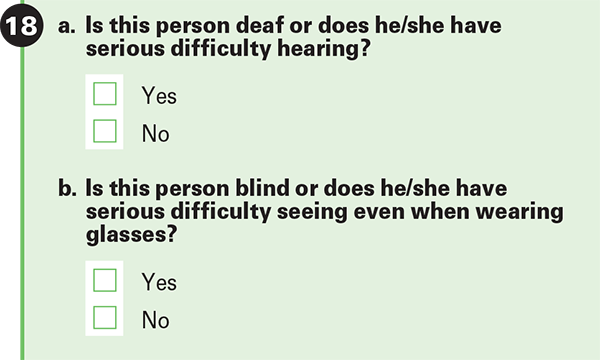
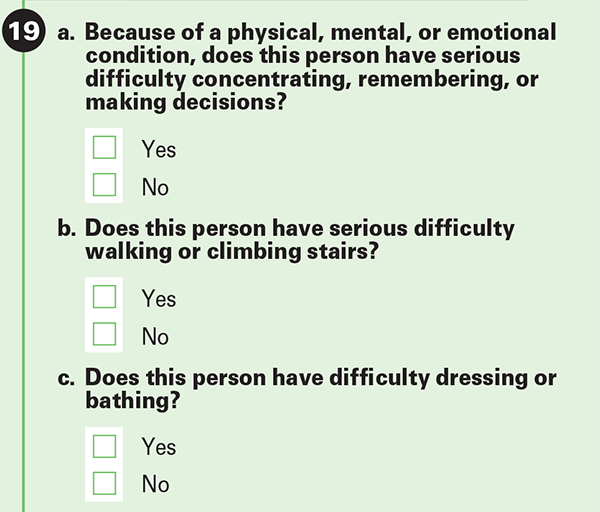
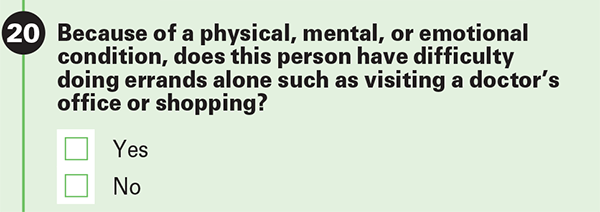
The Census Bureau uses table codes beginning with 18 to organize the main tables on disability. Most of these tables simply indicate ‘With a disability/No disability,’ but a few tables are further broken down by type of disability.
Code |
Title |
|---|---|
Disability |
|
| B18101‡† | Sex by Age by Disability Status |
| B18102‡ | Sex by Age by Hearing Difficulty |
| B18103‡ | Sex by Age by Vision Difficulty |
| B18104‡ | Sex by Age by Cognitive Difficulty |
| B18105‡ | Sex by Age by Ambulatory Difficulty |
| B18106‡ | Sex by Age by Self-care Difficulty |
| B18107‡ | Sex by Age by Independent Living Difficulty |
| B18108‡ | Age by Number of Disabilities |
| B18120‡ | Employment Status by Disability Status and Type |
| B18121‡ | Work Experience by Disability Status and Type |
| B18130‡ | Age by Disability Status by Poverty Status |
| B18131‡ | Age by Ratio of Income to Poverty Level by Disability Status and Type |
| B18135 | Age by Disability Status by Health Insurance Coverage Status |
| B18140 | Median Earnings by Disability Status by Sex for the Civilian Noninstitutionalized Population With Earnings |
|
‡Table also available in "collapsed" version: change "B" to "C" for table code. †Also available in racial iterations. |
|
Other Tables
Disability status is included in a small number of tables in other subject areas.
Code |
Title |
|---|---|
Disability Status |
|
| B10052 | Disability Status of Grandparents Living With Own Grandchildren by Responsibility for Own Grandchildren and Age of Grandparent |
| B21007 | Age by Veteran Status by Poverty Status by Disability Status for the Civilian Population 18 Years and Over |
| B21100 | Service-connected Disability-rating Status and Ratings for Civilian Veterans 18 Years and Over |
| B22010‡ | Receipt of Food Stamps/SNAP by Disability Status for Households |
| B23024 | Poverty Status by Disability Status by Employment Status for the Population 20 to 64 Years |
| B26108 | Group Quarters Type (3 Types) by Age by Disability Status |
| B26208 | Group Quarters Type (5 Types) by Age by Disability Status |
|
‡Table also available in "collapsed" version: change "B" to "C" for table code. |
|