
Employment
Overview
The Census Bureau asks a number of questions about whether individuals are employed and about their occupation and industry. Information from these questions is gathered together under the tag 'employment' in this tool. There are also questions about where geographically people are employed, how they get to work, how long it takes to get to work, and similar questions, which we collect under the tag 'commute.'
All data sources are from the American Community Survey unless otherwise noted.
Indicators on the Profile Page |
Why It's Important |
|---|---|
Employment |
|
|
|
Opportunity Youth |
|
|---|---|
|
|
Methodology
American Community Survey Data
While the ACS is not always the best source for employment data, it provides interesting information for small geographies that other sources don’t cover.
From the Census: Why We Ask: Employment Status
From the Census: Why We Ask: Industry, Occupation, and Class of Worker
From the Census: Why We Ask: Work Status Last Year
Sample Survey Questions on this Topic
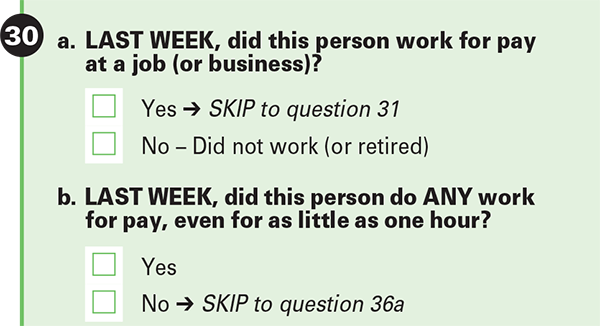
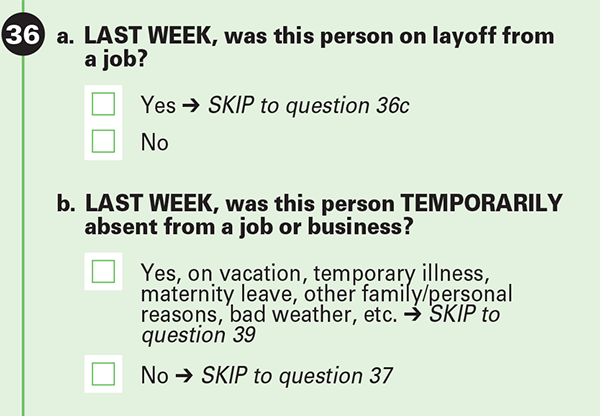
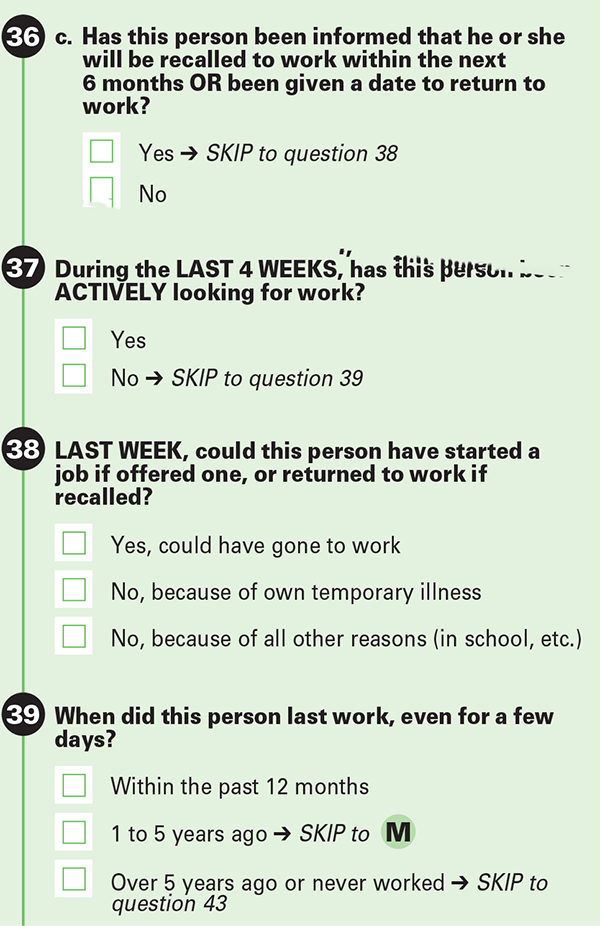
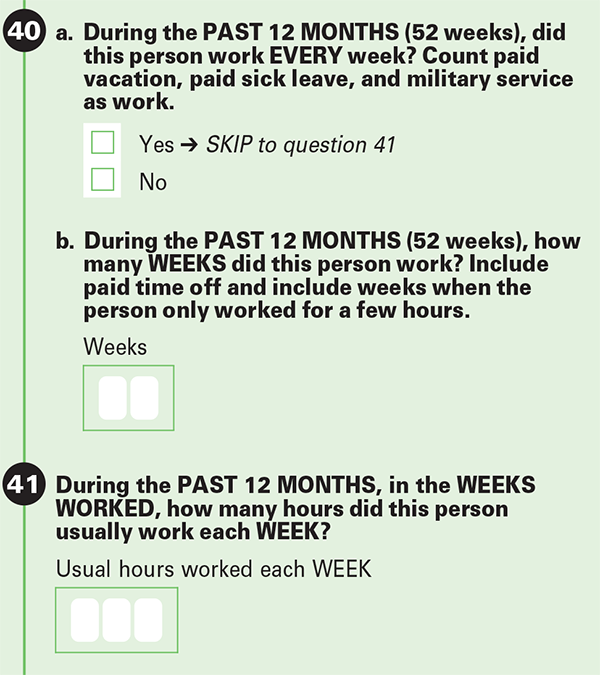
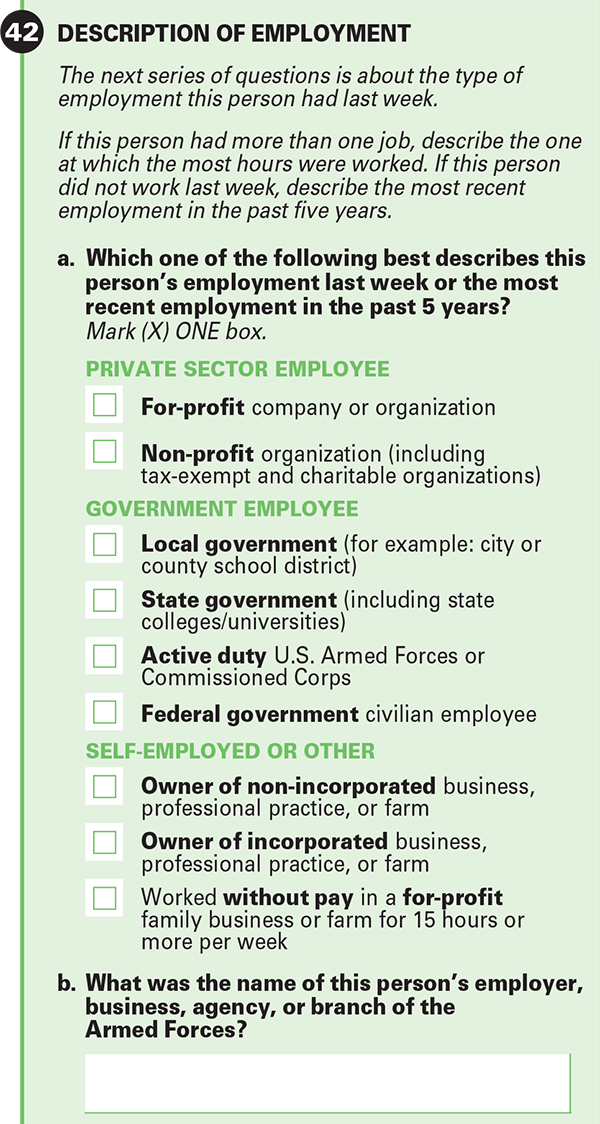
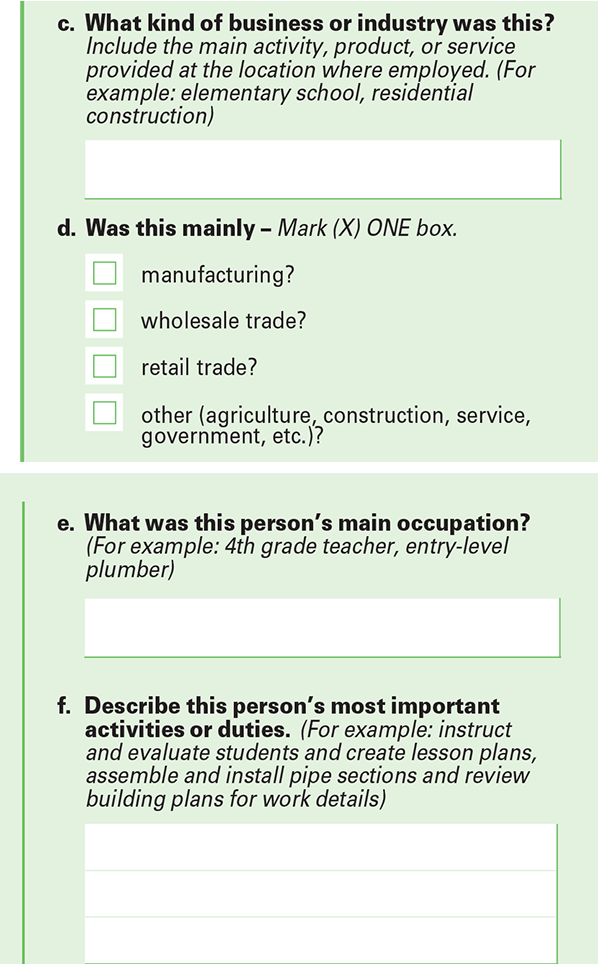
Employment Status
When talking about employment status, the Census Bureau divides the population 16 years and older into two categories: in the labor force or not in the labor force. People who have never worked or who are retired are not in the labor force. People who are not currently working but have recently and would like to work are considered in the labor force, but unemployed. People who are actively working are described as either in the civilian labor force or in the armed forces. This is probably easier understood when shown as a set of nested lists:
- Total:
- In labor force:
- Civilian labor force:
- Employed
- Unemployed
- Armed Forces
- Civilian labor force:
- Not in labor force
- In labor force:
The simplest presentation of this data is in table B23025 which has simply those columns. For finer detail, table B23001 breaks down those respondents into male and female and then within the sexes, into age brackets of varying sizes. In the ACS 1-year release, a collapsed version of this table, C23001 has the same basic structure but fewer distinct age brackets.
Employment status is reported by sex, age and race in the B23002 and C23002 series of tables. Neither of these tables appear in a non-racial tabulation, but each is tabulated in the standard nine subsets for race and hispanic origin. The C23002 tables have only two age brackets: 16-64 and 65 and older. The C23002 tables are available for all releases, but the B23002 table is only offered in the ACS 1-year release.
There are dozens more tables which cross tabulate employment status with other characteristics, such as education, poverty status, disability status, veteran status and more.
In the table below, some table names have been simplified. Employment status is always only for the population 16 years and over. Questions about work status and hours worked are for the last 12 months. References to the respondent's "own children" are for children under 18 years.
Code |
Title |
|---|---|
Employment Status |
|
| B23001‡ | Sex by Age by Employment Status |
| B23002A‡† | Sex by Age by Employment Status (racial iterations) |
| B23003 | Presence of Own Children by Age of Own Children by Employment Status for Females 20 to 64 Years |
| C23004*º | Work Status by Employment Status for the Civilian Population 65 Years and Over |
| B23006 | Educational Attainment by Employment Status for the Population 25 to 64 Years |
| B23007‡ | Presence of Own Children by Family Type by Employment Status |
| B23008‡ | Age of Own Children in Families and Subfamilies by Living Arrangements by Employment Status of Parents |
| B23009 | Presence of Own Children by Family Type by Number of Workers in Family |
| B23010 | Presence of Own Children in Married-couple Families by Work Experience of Householder and Spouse |
| B23013 | Median Age by Sex for Workers 16 to 64 Years |
| B23018 | Aggregate Usual Hours Worked by Sex for Workers 16 to 64 Years |
| B23020 | Mean Usual Hours Worked for Workers 16 to 64 Years |
| B23022‡ | Sex by Work Status by Usual Hours Worked Per Week by Weeks Worked for the Population 16 to 64 Years |
| B23024 | Poverty Status by Disability Status by Employment Status for the Population 20 to 64 Years |
| B23025 | Employment Status |
| B23026 | Sex by Work Status by Usual Hours Worked Per Week by Weeks Worked |
| B23027 | Full-time, Year-round Work Status by Age |
|
*No basic 'B' table is offered. †Also available in racial iterations. ‡Table also available in "collapsed" version: change "B" to "C" for table code. ºOnly available as part of the American Community Survey 1-year publication at data.census.gov, but are not included on State of the Child. |
|
Industry / Occupation / Class of Worker
The ACS provides some pretty detailed information about the specific kinds of work Americans do. These tables are gathered together in a series whose table codes begin with B24 and C24.
Occupation
The "detailed occupation" tables include over 500 occupations, but are only available summarized at the national level. Below the national level, begin with tables B24010 and B24020 to analyze the work people do in a place. In these and the other occupation tables, occupations are organized into five high level groups:
- Management, business, science, and arts occupations
- Natural resources, construction, and maintenance occupations
- Production, transportation, and material moving occupations
- Sales and office occupations
- Service occupations
In different tables, these groups are subdivided to varying depths. For B24010/B24020, there are a total of 150 columns for each of male and female workers. These columns are nested so that some values represent the total of columns below them. If you do your own summing, Be careful not to double-count by mixing columns of different depths.
Important: the ACS 5-year release does not include the B24010/B24020 tables. To analyze occupation data for smaller geographies, you must use the C24010/C24020 tables. These have the same five high level groups, but are broken down into only 35 columns for each of male and female workers.
Industry
In addition to the work Americans do, the ACS counts the industries in which they do that work. In these tables, there are 13 top level categories for industries. As with occupations, be careful not to double-count if you are doing your own summing.
These are the 13 top-level industries:
- Agriculture, forestry, fishing and hunting, and mining
- Arts, entertainment, and recreation, and accommodation and food services
- Construction
- Educational services, and health care and social assistance
- Finance and insurance, and real estate and rental and leasing
- Information
- Manufacturing
- Other services, except public administration
- Professional, scientific, and management, and administrative and waste management services
- Public administration
- Retail trade
- Transportation and warehousing, and utilities
- Wholesale trade
Class of Worker
These are the tabulation options for "class of worker."
- Private for-profit wage and salary workers:
- Employee of private company workers
- Self-employed in own incorporated business workers
- Private not-for-profit wage and salary workers
- Local government workers
- State government workers
- Federal government workers
- Self-employed in own not incorporated business workers
- Unpaid family workers
In some cross-tabulations, the three classes of government work are collapsed into one. Also, in some cross-tabulations, "Self-employed in own not incorporated business workers" and "unpaid family workers" are combined.
Industry / Occupation / Class of Worker table details
Below is a summary of all the tables that the Census Bureau includes in the "Industry / Occupation / Class of Worker" series. For the following tables, all references to employment are for the civilian population 16 years and older. Median earnings are for the last 12 months in dollars adjusted to the year of the ACS release.
Code |
Title |
|---|---|
Industry / Occupation / Class of Worker |
|
| B24010†‡º | Sex by Occupation for the Civilian Population |
| B24011 | Occupation by Median Earnings for the Civilian Population |
| B24012 | Sex by Occupation and Median Earnings for the Civilian Population |
| B24020༠| Sex by Occupation for the Full-time, Year-round Civilian Population |
| B24021 | Occupation by Median Earnings for the Full-time, Year-round Civilian Population |
| B24022 | Sex by Occupation and Median Earnings for the Full-time, Year-round Civilian Population |
| B24030༠| Sex by Industry for the Civilian Population |
| B24031 | Industry by Median Earnings for the Civilian Population |
| B24032 | Sex by Industry and Median Earnings for the Civilian Population |
| B24040༠| Sex by Industry for the Full-time, Year-round Civilian Population |
| B24041 | Industry by Median Earnings for the Full-time, Year-round Civilian Population |
| B24042 | Sex by Industry and Median Earnings for the Full-time, Year-round Civilian Population |
| B24050༠| Industry by Occupation for the Civilian Population |
| B24060༠| Occupation by Class of Worker for the Civilian Population |
| B24070༠| Industry by Class of Worker for the Civilian Population |
| B24080‡ | Sex by Class of Worker for the Civilian Population |
| B24081 | Class of Worker by Median Earnings for the Civilian Population |
| B24082 | Sex by Class of Worker and Median Earnings for the Civilian Population |
| B24090‡ | Sex by Class of Worker for the Full-time, Year-round Civilian Population |
| B24091 | Class of Worker by Median Earnings for the Full-time, Year-round Civilian Population |
| B24092 | Sex by Class of Worker and Median Earnings for the Full-time, Year-round Civilian Population |
|
†Also available in racial iterations. ‡Table also available in "collapsed" version: change "B" to "C" for table code. ºOnly available as part of the American Community Survey 1-year publication at data.census.gov, but are not included on State of the Child. |
|
Detailed Occupation Data
As mentioned above, a few tables offer a very detailed breakdown of occupations—over 500 columns. However, data for these tables is only available for the United States as a whole, and not for any smaller geography.
Code |
Title |
|---|---|
Industry / Occupation / Class of Worker |
|
| B24114º | Detailed Occupation for the Civilian Population |
| B24115º | Detailed Occupation for the Civilian Employed Male Population |
| B24116º | Detailed Occupation for the Civilian Employed Female Population |
| B24121 | Detailed Occupation by Median Earnings for the Full-time, Year-round Civilian Population |
| B24122 | Detailed Occupation by Median Earnings for the Full-time, Year-round Civilian Employed Male Population |
| B24123 | Detailed Occupation by Median Earnings for the Full-time, Year-round Civilian Employed Female Population |
| B24124 | Detailed Occupation for the Full-time, Year-round Civilian Population |
| B24125 | Detailed Occupation for the Full-time, Year-round Civilian Employed Male Population |
| B24126 | Detailed Occupation for the Full-time, Year-round Civilian Employed Female Population |
| B24134º | Detailed Industry for the Civilian Population |
| B24135º | Detailed Industry for the Civilian Employed Male Population |
| B24136º | Detailed Industry for the Civilian Employed Female Population |
|
ºOnly available as part of the American Community Survey 1-year publication at data.census.gov, but are not included on State of the Child. |
|