Language
Overview
Information about which languages survey respondents speak at home and their relative proficiency in English.
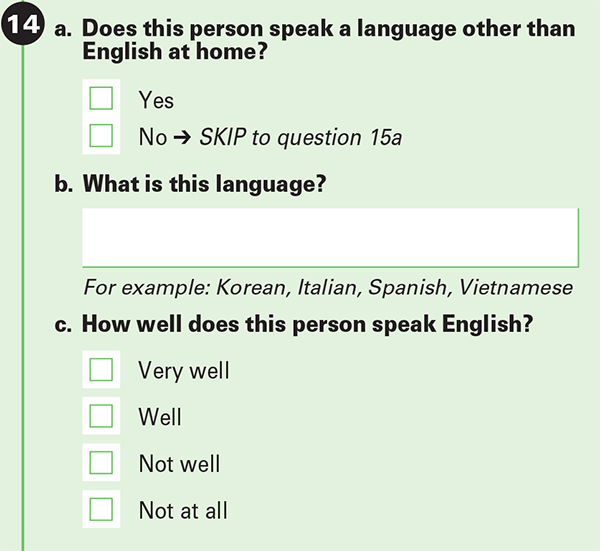
The American Community Survey (ACS) asks respondents if they speak a language other than English at home, then asks those who do to specify which language. These respondents are also asked to self-report how well they speak English, so these terms are up to individual interpretation:
- Very well
- Well
- Not well
- Not at all
Except for tables B16001 and C16001, which are quite detailed, languages are broadly categorized into:
- English
- Spanish
- Other Indo-European languages
- Asian and Pacific Island languages
- Other languages
This information is used to support language assistance, such as providing translations of documents or interpreters for services.
All data sources are from the American Community Survey unless otherwise noted.
Indicators on the Profile Page |
Why It's Important |
|---|---|
Language at home |
|
|
|
Methodology
American Community Survey Data
While it might be taken for granted that a person who is born in the U.S. is "native," note that people born in Puerto Rico, American Samoa, Guam, the Commonwealth of the Northern Mariana Islands, or the US Virgin Islands also qualifies as "native," as well as those born in a foreign country who have at least one parent who is a U.S. citizen. Thus, by definition, anyone who is "native" is a citizen. People who are not "native" are classified as "foreign born," and may be either a "naturalized citizen" or not a citizen.
Separately from asking about citizenship, the ACS asks about each person the location of their birth, be it a state in the U.S. or another country, and, if not born in the United States, the year that the person came to live in the United States.
One interesting table, Period of Naturalization (B05011), counts the number naturalized citizens over 5 year periods, allowing you to track naturalization rates over time.
From the Census: Why We Ask: Language Spoken at Home
Sample Survey Questions on this Topic
Code |
Title |
|---|---|
Language |
|
| B16001‡ | Language Spoken at Home by Ability to Speak English |
| B16002‡ | Detailed Household Language by Household Limited English Speaking Status |
| B16003‡† | Age by Language Spoken at Home in Limited English Speaking Households |
| B16004‡ | Age by Language Spoken at Home by Ability to Speak English |
| B16005‡ | Nativity by Language Spoken at Home by Ability to Speak English |
| B16006‡ | Language Spoken at Home by Ability to Speak English (Hispanic or Latino) |
| B16007‡ | Age by Language Spoken at Home |
| B16008‡ | Citizenship Status by Age by Language Spoken at Home and Ability to Speak English |
| B16009‡ | Poverty Status by Age by Language Spoken at Home |
| B16010‡ | Educational Attainment and Employment Status by Language Spoken at Home |
|
†Also available in racial iterations. ‡Table also available in "collapsed" version: change "B" to "C" for table code. |
|
Other ACS Tables Referencing Language
Code |
Title |
|---|---|
Language |
|
| B06007ठ| Place of Birth by Language Spoken at Home and Ability to Speak English in the United States |
| B08113‡ | Means of Transportation to Work by Language Spoken at Home and Ability to Speak English |
| B08513‡ | Means of Transportation to Work by Language Spoken at Home and Ability to Speak English for Workplace Geography |
| B10054 | Language and Ability to Speak English of Grandparents Living With Own Grandchildren by Responsibility for Own Grandchildren and Age of Grandparent |
| B26113 | Group Quarters Type (3 Types) by Language Spoken at Home by Ability to Speak English |
| B26213 | Group Quarters Type (5 Types) by Language Spoken at Home by Ability to Speak English |
|
†Also available in racial iterations. ‡Table also available in "collapsed" version: change "B" to "C" for table code. §Tabulated for Puerto Rico. Add 'PR' to the table code. Column names may vary slightly from non-PR version. |
|