
Poverty
Overview
The poverty rate is the standard measure of economic distress used in the United States. Since the methodology for calculating it hasn’t been updated since the 1970s, it is often regarded as an imprecise indicator, but the poverty rate (or measures based on multiples of it, such as 185% of the poverty level) are still used in determining who qualifies for many policies. The poverty rate is still critical in understanding where residents may most benefit from various programs and supports.
Take Action!
Is this an issue you care about? Connect with one of the organizations below to find resources and support on this topic.

Wayne Metro Community Action Agency
In their pursuit to eliminate poverty, Wayne Metro empowers people and communities to be strong, healthy, and thriving. Connect with them now to take action and/or get help!

United Way
United Way works to advance equitable communities where households are stable and children thrive. Connect with them now to take action and/or get help!
All data sources are from the American Community Survey unless otherwise noted.
Indicators on the Profile Page |
Why It's Important |
|---|---|
Child Poverty |
|
|
|
Poverty |
|
|---|---|
|
|
Methodologies
American Community Survey Data
The American Community Survey has many different tables that address the topic of poverty. Note that, while conversationally, people refer to the poverty level, there is no single number. The Census Bureau computes 48 different poverty income levels, based mostly on family size, and, for 1-2 person households, separate numbers for senior citizens. For more details, including links to the specific poverty levels, see How the Census Bureau Measures Poverty.
Some people call out the official poverty income levels as being very low, pointing out that many people who are not officially living in poverty still have a hard time making ends meet. Tables referring to "ratio of income to poverty level" can help to get a broader count of people experiencing economic hardship. (See also housing tables presenting housing costs as a percentage of household income.)
Some table names have been simplified. References to poverty status/level or receipt of food stamps/SNAP are always for the last 12 months.
From the Census: Why We Ask: Income
From the Census: Why We Ask: Food Stamps/Supplemental Nutrition Assistance Program (SNAP)
Sample Survey Questions on this Topic
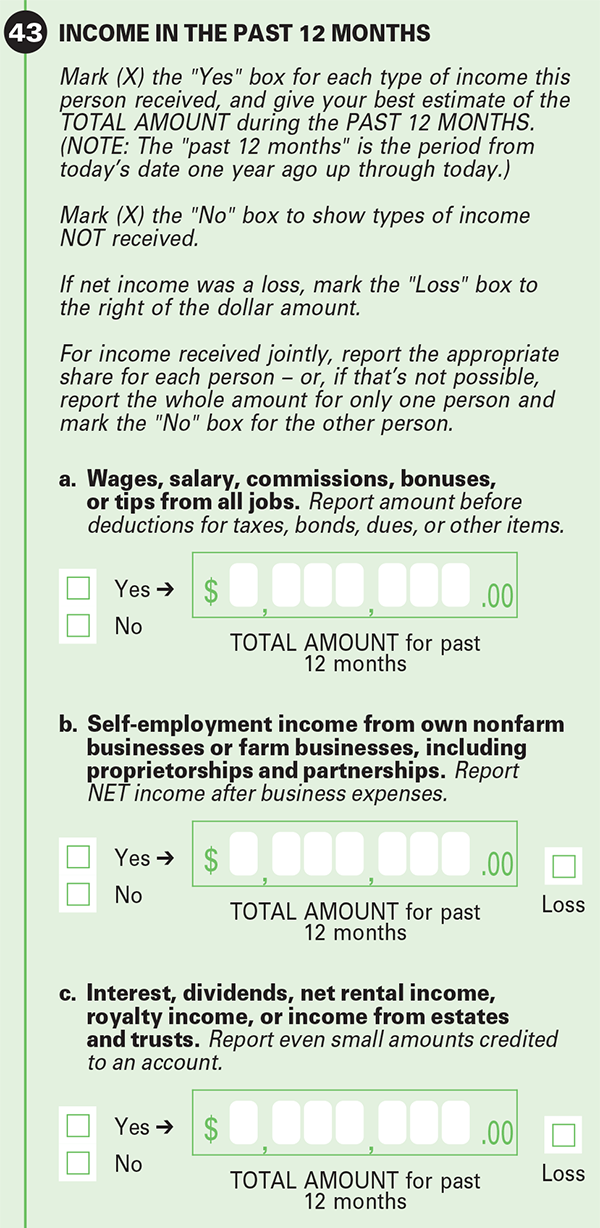
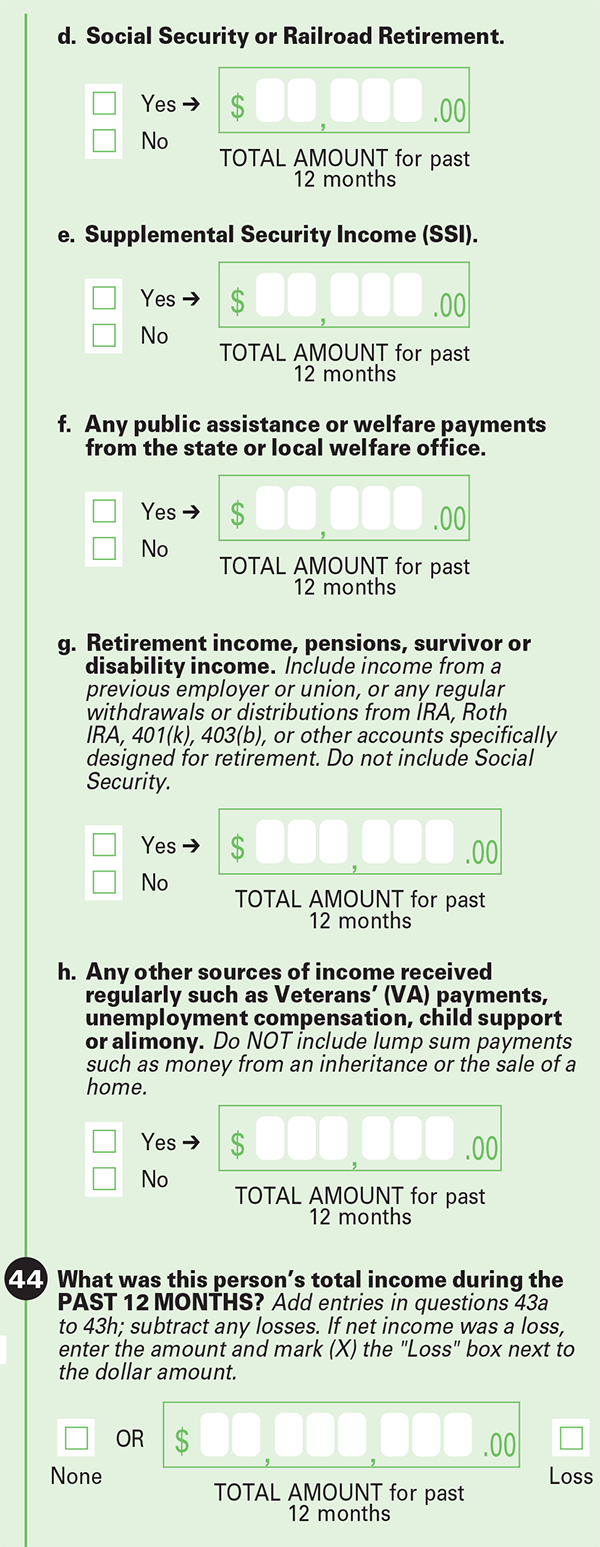
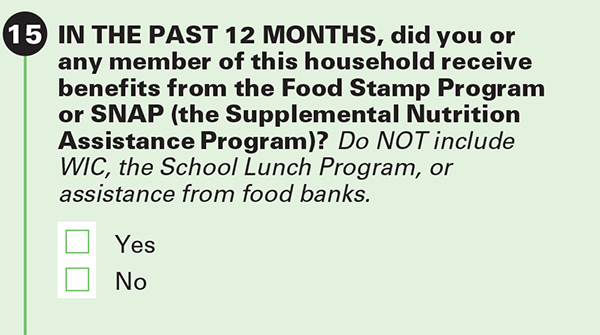
| Code | Title |
|---|---|
| B17001†‡ | Poverty Status by Sex by Age |
| B17002‡ | Ratio of Income to Poverty Level |
| B17003‡ | Poverty Status of Individuals by Sex by Educational Attainment |
| B17004‡ | Poverty Status of Individuals by Sex by Work Experience |
| B17005 | Poverty Status of Individuals by Sex by Employment Status |
| B17006‡ | Poverty Status of Related Children Under 18 Years by Family Type by Age of Related Children Under 18 Years |
| B17007‡ | Poverty Status of Unrelated Individuals 15 Years and Over by Sex by Age |
| B17008 | Aggregate Income Deficit (Dollars) of Unrelated Individuals by Sex |
| B17009‡ | Poverty Status by Work Experience of Unrelated Individuals by Householder Status |
| B17010†‡ | Poverty Status of Families by Family Type by Presence of Related Children Under 18 Years by Age of Related Children |
| B17011 | Aggregate Income Deficit (Dollars) for Families by Family Type |
| B17012‡ | Poverty Status of Families by Household Type by Number of Related Children |
| B17013‡ | Poverty Status of Families by Household Type by Number of Persons in Family |
| B17014‡ | Poverty Status of Families by Household Type by Number of Workers in Family |
| B17015‡ | Poverty Status of Families by Family Type by Social Security Income by Supplemental Security Income (SSI) and Cash Public Assistance Income |
| B17016‡ | Poverty Status of Families by Family Type by Work Experience of Householder and Spouse |
| B17017‡ | Poverty Status by Household Type by Age of Householder |
| B17018‡ | Poverty Status of Families by Household Type by Educational Attainment of Householder |
| B17019‡ | Poverty Status of Families by Household Type by Tenure |
| B17020ª | Poverty Status by Age (racial iterations) |
| B17021‡ | Poverty Status of Individuals by Living Arrangement |
| B17022‡ | Ratio of Income to Poverty Level of Families by Family Type by Presence of Related Children Under 18 Years by Age of Related Children |
| B17023‡ | Poverty Status of Families by Household Type by Number of Own Children Under 18 Years |
| B17024‡ | Age by Ratio of Income to Poverty Level |
| B17025‡ | Poverty Status by Nativity |
| B17026‡ | Ratio of Income to Poverty Level of Families |
| B17101 | Poverty Status of People in Housing Units |
|
‡Table also available in "collapsed" version: change "B" to "C" for table code. †Also available in racial iterations. ªNo basic table is offered–only racial iteration tables. |
|
Other ACS Tables Referencing Poverty
Some table names below have been simplified. References to poverty status/level or receipt of food stamps/SNAP are always for the last 12 months.
| Code | Title |
|---|---|
| B05010 | Ratio of Income to Poverty Level by Nativity of Children Under 18 Years in Families and Subfamilies by Living Arrangements and Nativity of Parents |
| B06012 | Place of Birth by Poverty Status in the United States |
| B07012 | Geographical Mobility in the Past Year by Poverty Status for Current Residence in the United States |
| B07412 | Geographical Mobility in the Past Year by Poverty Status for Residence 1 Year Ago in the United States |
| B08122 | Means of Transportation to Work by Poverty Status |
| B08522 | Means of Transportation to Work by Poverty Status for Workplace Geography |
| B10059 | Poverty Status of Grandparents Living With Own Grandchildren Under 18 Years by Responsibility for Own Grandchildren and Age of Grandparent |
| B13010 | Women 15 to 50 Years Who Had a Birth in the Past 12 Months by Marital Status and Poverty Status |
| B14006 | Poverty Status by School Enrollment by Level of School for the Population 3 Years and Over |
| B16009 | Poverty Status by Age by Language Spoken at Home for the Population 5 Years and Over |
| B18130 | Age by Disability Status by Poverty Status |
| B18131 | Age by Ratio of Income to Poverty Level by Disability Status and Type |
| B21007 | Age by Veteran Status by Poverty Status by Disability Status for the Civilian Population 18 Years and Over |
| B22003 | Receipt of Food Stamps/SNAP by Poverty Status for Households |
| B22005ª | Receipt of Food Stamps/SNAP by Race of Householder |
| B23024 | Poverty Status by Disability Status by Employment Status for the Population 20 to 64 Years |
| B27016 | Health Insurance Coverage Status and Type by Ratio of Income to Poverty Level by Age |
| B27017 | Private Health Insurance by Ratio of Income to Poverty Level by Age |
| B27018 | Public Health Insurance by Ratio of Income to Poverty Level by Age |
|
†Also available in racial iterations. ªNo basic table is offered–only racial iteration tables. |
|