
Families and Households
Overview
Households are a major frame through which Census data is tabulated. Many social and economic questions make more sense when framed by the household unit rather than by individuals.
The census concept of "family" is closely related to "household," so it's worth understanding the distinction. Specifically, a household includes all the people who occupy a housing unit (such as a house or apartment) as their usual place of residence, regardless of whether they are related. There are also households of one person living alone, households where everyone is related, households where some people are related and others aren’t, and households where none of the people are related to each other. Note that the count of households excludes group quarters.
There are two major categories of households: “family” and “nonfamily.” A family is a household where two or more people are related by birth, marriage, or adoption. A nonfamily household is either one person living alone or more than one person living together who are not related by birth, marriage, or adoption.
All data sources are from the American Community Survey unless otherwise noted.
Indicators on the Profile Page |
Why It's Important |
|---|---|
Household characteristics |
|
|
|
Families with children |
|
|---|---|
|
|
Methodology
American Community Survey Data
The ACS table numbers beginning with 11 are the primary tables about Families and Households. There are 16 tabulations in this group, along with various collapsed versions and racial iterations.
If your research involves family, you may also be interested in a number of tables specifically about Children. There are also several tabulations which include Family Type as a factor. For detailed information about how the Census Bureau tabulates family data, for the ACS and other products, see the Families and Living Arrangements page.
From the Census: Why We Ask: Relationship to Householder
From the Census: Why We Ask: Marital Status / Marital History
Sample Survey Questions on this Topic
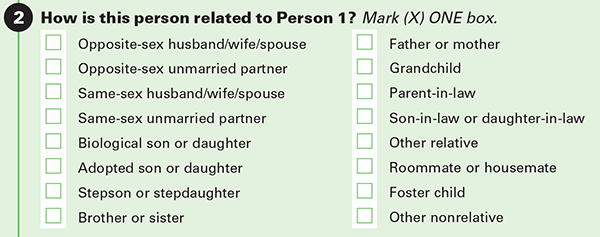
These are the primary family/household tabulations:
| Code | Title |
|---|---|
Families and Households |
|
| B11001† | Household Type (Including Living Alone) |
| B11002† | Household Type by Relatives and Nonrelatives for Population in Households |
| B11003 | Family Type by Presence and Age of Own Children |
| B11004 | Family Type by Presence and Age of Related Children |
| B11005‡ | Households by Presence of People Under 18 Years by Household Type |
| B11006 | Households by Presence of People 60 Years and Over by Household Type |
| B11007 | Households by Presence of People 65 Years and Over, Household Size and Household Type |
| B11008 | Cohabiting Couple Households by Presence and Age of Own Children |
| B11009 | Coupled Households by Type |
| B11010‡ | Nonfamily Households by Sex of Householder by Living Alone by Age of Householder |
| B11011 | Household Type by Units in Structure |
| B11012 | Households by Type |
| B11013‡ | Subfamily Type by Presence of Own Children |
| B11014‡ | Population in Subfamilies by Subfamily Type by Relationship |
| B11015 | Households by Presence of Nonrelatives |
| B11016‡ | Household Type by Household Size |
| B11017 | Multigenerational Households |
|
†Also available in racial iterations. ‡Table also available in "collapsed" version: change "B" to "C" for table code. |
|
Householder
From the Census online glossary, a definition of householder:The person, or one of the people, in whose name the home is owned, being bought, or rented. If there is no such person present, any household member 15 years old and over can serve as the householder.
Two types of householders are distinguished: a family householder and a nonfamily householder. A family householder is a householder living with one or more people related to him or her by birth, marriage, or adoption. The householder and all people in the household related to him are family members.
A nonfamily householder is a householder living alone or with nonrelatives only.
Family type
The tables below include "family type" as one of the factors for reporting data. Family types include "married-couple", "female householder, no husband present", and "male householder, no wife present."
Since the 2013 ACS, "married-couple" families includes both opposite-sex and same-sex married couples. See Same-Sex Couples for some more information and links.
| Code | Title |
|---|---|
Family Type |
|
| B09002 | Own Children by Family Type and Age |
| B11003 | Family Type by Presence and Age of Own Children |
| B11004 | Family Type by Presence and Age of Related Children |
| B11013‡ | Subfamily Type by Presence of Own Children |
| B11014‡ | Population in Subfamilies by Subfamily Type by Relationship |
| B17006‡ | Poverty Status of Related Children by Family Type by Age of Related Children |
| B17010‡† | Poverty Status of Families by Family Type by Presence of Related Children by Age of Related Children |
| B17011 | Aggregate Income Deficit (Dollars) for Families by Family Type |
| B17015‡ | Poverty Status of Families by Family Type by Social Security Income by Supplemental Security Income (SSI) and Cash Public Assistance Income |
| B17016‡ | Poverty Status of Families by Family Type by Work Experience of Householder and Spouse |
| B17022‡ | Ratio of Income to Poverty Level of Families by Family Type by Presence of Related Children by Age of Related Children |
| B19126 | Median Family Income by Family Type by Presence of Own Children |
| B19128 | Aggregate Family Income by Family Type by Presence of Own Children |
| B19130 | Aggregate Family Income by Family Type by Age of Householder |
| B19131‡ | Family Type by Presence of Own Children by Family Income |
| B22007 | Receipt of Food Stamps/SNAP by Family Type by Number of Workers in Family |
| B23007‡ | Presence of Own Children by Family Type by Employment Status |
| B23009 | Presence of Own Children by Family Type by Number of Workers in Family |
|
†Also available in racial iterations. ‡Table also available in "collapsed" version: change "B" to "C" for table code. |
|